A proactive guide from someone currently in the thick of her 30s… figuring out what matters, what doesn’t, and what’s worth your money.
I found my first “is that a fine line or is the lighting just honest today” moment somewhere around 32. Standing in my bathroom, leaning toward the mirror the way you do. And my honest first reaction wasn’t panic — it was I have no idea what I’m actually supposed to be doing here.
Because here’s the thing about skincare in your 30s: there is an absolute avalanche of information out there, most of it trying to sell you something, and very little of it just telling you plainly what’s worth it. So that’s what I want to do here. This is the guide I wish I’d had — what actually changes, what actually helps, and where you can save your money.
A quick note before we start: I’m not a dermatologist, and if you have specific skin concerns, a real one is worth every penny. I’m just someone who did a lot of reading, sorted the science from the marketing, and figured out a routine that works without taking over my life. If it’s in this post, it earned its spot.
First — what’s actually happening to your skin
It helps to know what you’re working with, because it makes the “why” behind every tip click into place.
In your 30s, a few things quietly shift. Your skin cell turnover slows down — the roughly month-long cycle of your 20s gets longer, so dull surface cells hang around more than they used to. Your collagen production starts its slow decline (collagen is the protein scaffolding that keeps skin firm and bouncy). Your skin makes less of its own oil, so it gets drier and a little less resilient. And any sunbathing you did at 19 with zero protection? It starts showing up now as uneven tone and the odd dark spot. Past me has some explaining to do.
None of this is a problem to panic about. It’s just useful intel. Knowing it tells you exactly where to focus — so let’s focus.
The Skincare Part
If your 20s skincare routine was “wash face, maybe,” your 30s ask for a little more intention. But “more intentional” doesn’t mean a 12-step routine. It means a few things that genuinely work. Here are the ones worth your time.
Sunscreen is the whole ballgame
If you do exactly one thing from this entire post, make it this one. Daily sunscreen is, hands down, the single most effective anti-aging step available to anyone. The large majority of visible skin aging — the wrinkles, the loss of firmness, the dark spots — traces back to sun exposure, not birthdays. Which is honestly the most hopeful fact in skincare, because it means so much of it is preventable, starting today.
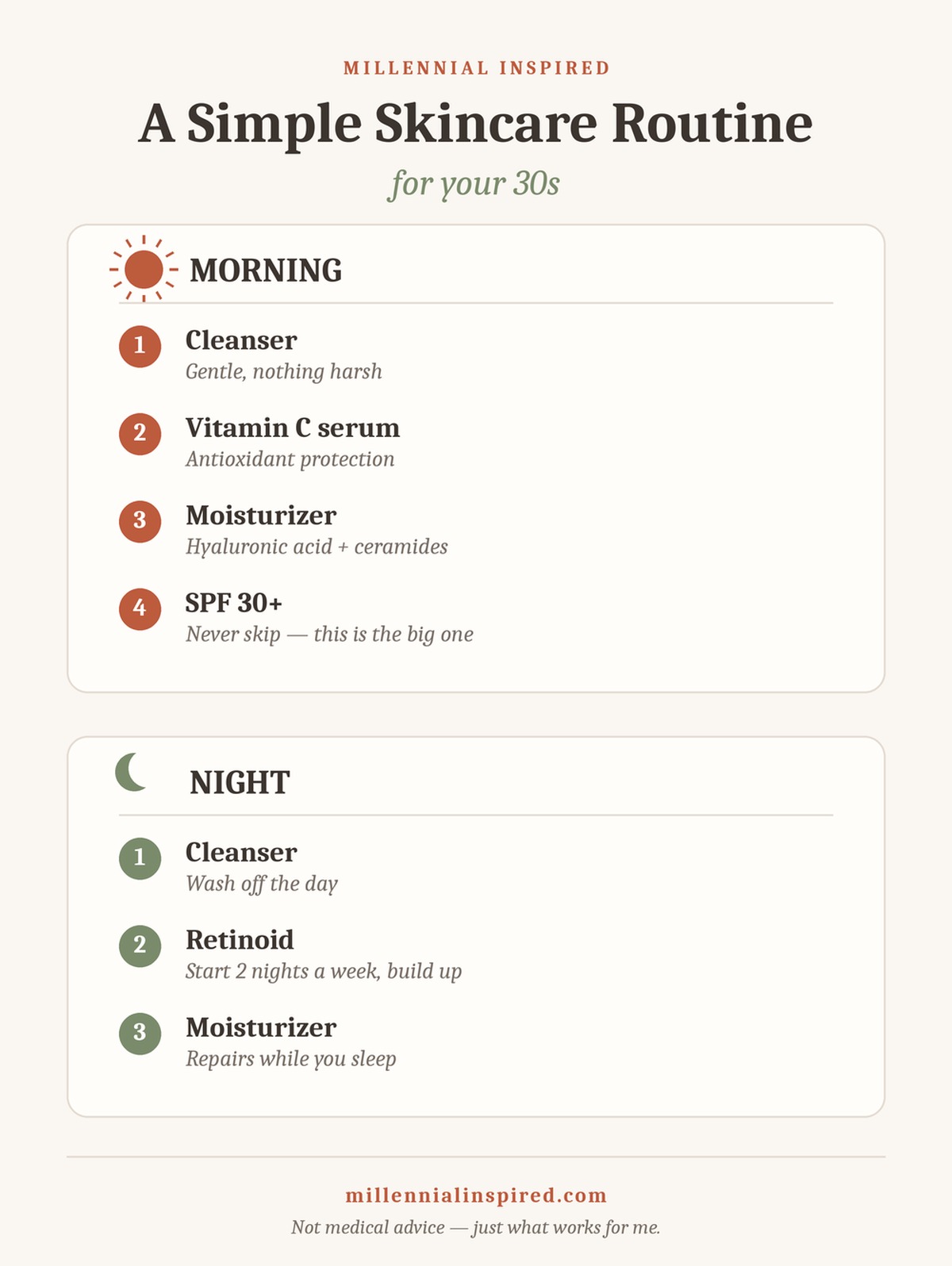
What I actually do: a broad-spectrum SPF 30 (or higher) every single morning, as the last step before makeup. Rain, shine, January, doesn’t matter — UV is still doing its thing through clouds and windows. And I take it down past my jaw: neck, chest, the backs of my hands. Those areas age right alongside your face and they’re so easy to forget. I keep mine by my coffee maker so I literally cannot miss it. Habits need anchors.
Retinoids — the one that actually earns the hype
Most skincare ingredients are a little oversold. Retinoids are the exception — they’re the genuine gold standard, and dermatologists are near-unanimous about them. They’re derived from Vitamin A, and they work by speeding your skin’s cell turnover back up and nudging collagen production along. Translation: smoother texture, fewer fine lines, more even tone over time.
What I actually do: I started slow, because retinoids will absolutely get their revenge if you go too hard too fast — the classic rookie mistake is slathering it on nightly out of enthusiasm and ending up red and peeling. An over-the-counter retinol, a pea-sized amount, two nights a week to start. Dry skin, after cleansing, moisturizer on top. You build up frequency as your skin adjusts. Patience is the whole strategy here.
One important note: retinoids make your skin more sun-sensitive, so they’re a nighttime thing, and they make tomorrow’s sunscreen non-negotiable. The two go together.
Hydration and antioxidants — your supporting cast
If sunscreen and retinoids are the leads, these are the reliable supporting players.
Hydration: as your skin holds onto less moisture on its own, you give it backup. The ingredient to know is hyaluronic acid — it’s a humectant, meaning it pulls water into the skin, and it can hold a remarkable amount of moisture for its weight. Ceramides and glycerin are also wonderful — they help reinforce your skin’s moisture barrier, the thing standing between you and that tight, parched winter-skin feeling.
Antioxidants: these are your daytime bodyguards. They help neutralize free radicals — the unstable molecules from pollution and UV that damage skin cells. Vitamin C is the one I’d start with: it’s a well-studied antioxidant that also brightens and supports collagen, and it pairs beautifully under sunscreen in the morning.
What I actually do: Vitamin C serum in the morning after cleansing, before moisturizer and SPF. At night, a moisturizer with hyaluronic acid and ceramides to repair while I sleep. That’s genuinely it.
A quick, honest aside on eye cream, since it always comes up: the skin around your eyes is thinner and shows everything first, so a dedicated eye cream is a nice thing, not a miracle thing. If you love the ritual (I kind of do), wonderful. If you’d rather skip it, dabbing your regular moisturizer gently around the eye area is honestly fine. Don’t let anyone guilt you on this one.
A note on the DIY side — what to make, what to buy
You might know I have a whole series on from-scratch body care — sugar scrubs, whipped body butter, that kind of thing. So let me be clear about where DIY fits in a 30s routine, because I’d never want this blog to send you the wrong direction.
The body-care stuff — scrubs, body butters, bath soaks — is genuinely great to make yourself. Simple, satisfying, cheap, and it works. But the heavy lifters in this post — sunscreen, retinoids, vitamin C — are exactly the things you should buy, properly formulated and tested. You can’t make reliable sunscreen in your kitchen, and a squeeze of lemon is not a vitamin C serum. Make the body butter; buy the SPF. I wrote a whole honest guide on where that line falls if you want it.
The Part That Isn’t Skincare At All
Here’s what surprised me most: a real chunk of “skincare in your 30s” isn’t skincare. It’s the boring, foundational stuff — and it’s free, which is more than I can say for a good vitamin C serum.
What you eat
Your skin is built from what you give your body. I’m not about to hand you a restrictive diet — this is a blog with a cast iron peach cobbler recipe, I’d never — but a few things genuinely help your skin do its job: colorful fruits and vegetables (the antioxidants again), healthy fats like avocado, nuts, and salmon for that omega-3 suppleness, and enough protein, since that’s the raw material for collagen and elastin.
The farmers-market way I already like to eat does most of this without trying. “Eat the rainbow, mostly” is about as prescriptive as I’ll get.
Sleep
Beauty sleep is, annoyingly, real. While you sleep your skin shifts into repair mode — rebuilding collagen, recovering from the day. Skimp on it consistently and skin looks duller and tireder, no serum fully fixes that. I aim for 7–9 hours and protect my wind-down routine: a book, a warm shower, screens off before bed. My ideal night in, honestly, sells itself.
Stress
Chronic stress raises cortisol, and sustained high cortisol actually breaks down collagen and elastin — the exact proteins you’re trying to protect. You cannot serum your way out of a genuinely overwhelming season of life.
I’m not going to tell you to “just relax.” But carving out even fifteen unbothered minutes a day — a walk, deep breathing, a hobby with no productive purpose whatsoever — does more for your skin than the last step of anyone’s 10-step routine. It counts as skincare. I’m counting it.
Movement
Moving your body boosts circulation, which delivers oxygen and nutrients to your skin and clears out waste — your skin genuinely looks better for it. It also helps with sleep and stress, so it pays you back three ways. Find something you’ll actually keep doing. A hike when our Tennessee fall shows off, a walk with a podcast, a dance break in the kitchen. The “best” exercise is the one you don’t dread.
What I’d Actually Tell a Friend
If you came over for coffee and asked me where to start, I wouldn’t recite this whole list. I’d say: wear sunscreen every morning, no exceptions. Once that’s a habit, add a vitamin C serum in the morning and start a retinol a couple nights a week. Layer in a good moisturizer. Then look at your sleep before you look at your shopping cart again.
That’s a routine you can build in a month, mostly with a handful of products, and it sets your skin up for the next decade better than any panic-buy ever could.
Your 30s aren’t about fighting your face. The goal was never to look 22 — it’s to keep your skin healthy and comfortable and to feel good in it. Be patient, be consistent, let the small daily choices compound. That’s the whole secret, and it’s a genuinely good one.
Now — anyone else need to go put sunscreen on? Just me? I’ll go first.
Not a dermatologist, just someone who did the reading so you don’t have to. If you’ve got a skincare concern that’s actually bothering you, please see a professional — that’s what they’re there for. For everything else: start with the sunscreen, and I’ll see you in the next post.